Islamic finance
Prospects of cooperation between Uzbekistan and the Islamic Development Bank Group in the context of textile industry development
This study assesses the potential of contribution of Islamic Development Bank Group into the economic development of Uzbekistan, increase of productivity of state financial system and realization of certain goals of textile industry development.
Introduction.
One of the important components of the development of any state economy is the provision of financial support to economic entities of strategically important sectors of the economy that are capable of producing competitive goods at the global level. Support of such entities with the help of preferential lending and (or) insurance, on conditions below market ones, allows to maintain and create new jobs, increase the scale of the enterprise’s activities, allowing to counteract manifestations of economic instability more effectively, as well as to deepen international economic relations with other countries, contributing to long-term economic growth of the country.
Long-term financing of projects of various segments is carried out, among others, by multilateral development banks that emerged in the period after the Second World War. The activities of global (World Bank) and regional development banks (European Bank for Reconstruction and Development, Asian Development Bank, African Development Bank, Inter-American Development Bank) have had a huge impact on solving social problems, implementing structural reforms in developing countries, mitigating the consequences of financial and economic crises, and strengthening economic integration processes at the regional level.
The Islamic Development Bank (IDB) played an important role in intensifying the development of mutual trade between countries at the regional level, in countering the food crisis and chronic poverty. It was created in accordance with the decision of the Conference of Arab Foreign Ministers in Lahore (Pakistan) in February 1974, and officially began its work only on October 20, 1975. Today, IDB is part of the Islamic Development Bank Group (IsDB), consisting of 5 structural divisions. As at December 31, 2022, there were 57 member States, of which Saudi Arabia, Libya and Iran remain the largest shareholders.
Uzbekistan joined IDB, being the core division of the Group, only in September 2003 during the annual meeting of the Board of Directors in Almaty, thus becoming the last member of all the countries of the post-Soviet space to join this organization. A cooperation between two parties started to intensify only during the last 4-5 years. Still there is a huge untapped potential in relationship of Uzbekistan and IsDB, which can be used towards development of textile industry enterprises, strengthening the national financial system, acceleration of economic growth in the country, enhancing financial literacy of population and financial resilience of legal entities.
Literature review.
It should be noted that the first attempts to establish banks based on Shariah principles emerged in the 1950s and insurance companies – in 1970s in the Middle East region. However, Islamic financial institutions started to play a significant role in the world economy only since early 1990s with the growth of economic and financial power of certain Arab countries within the framework of the Islamic economy doctrine. During this period a lot of scientists and experts, including Chapra M Umer [7], Khan, M. S., A. Mirakhor [19], M Kabir Hassan [10], started publishing several studies about the basic features of the Islamic finance and banking, large-scale growth in Muslim countries based on Shariah principles, remaining problems and challenges relating to Islamic instruments, financial markets, and regulations. Establishment of “Accounting and Auditing Organization for Islamic Financial Institutions” (AAOIFI) in 1991 allowed to maintain and promote Shariah standards for Islamic financial institutions, participants, and the overall industry. This had led to development of scientific base on Islamic finance and new practical methods and mechanisms of managing currency and financial flows, introducing innovative financial technologies, developing investment solutions.
The independence of the former Soviet republics, occurrence of several financial crises prompted these countries to seek alternative sources of financing and development of their economies in cooperation with Muslim countries in general and IDB in particular. This predetermined the relevance of the study of several researchers (Andrianov V.D. [4], Bekkin R.I. [5], Hadiullina G.N. [9]), Juravlev A.Yu. [18], Isaeva E.A. [13], Kenzhaliev N.U. [14], Imamkulieva E.E. [11], Kyrlan M.G. [16]), who assessed the trends and directions of formation of the Islamic finance industry in the post-Soviet practice. A significant contribution to the study of the specifics of Islamic financial institutions and their role in global finance was made by Bekkin R.I.
In terms of Uzbekistan’s perspective, Geoffrey F. Gresh [8] in the mid of 2000s displayed the rise of Islamic financial system in Central Asian countries and Uzbekistan’s desire to incorporate greater Islamic components into government since the early 2000s. Uzbek scientist, former rector of Tashkent Islamic University, Abdullaev R.V. [1-3] in his works reviewed in details the relationship of Uzbekistan with IDB, large-scale financed projects by the Bank during the whole period of cooperation. A thorough analytical study was done by Imamnazarov J. [12] in 2020, who delved into the essential characteristics of Islamic financial instruments and prerequisites for their implementation in Uzbekistan. According to his research, Uzbekistan, unlike its neighboring countries, hasn’t started the process of developing a legal framework for activity of Islamic financial institutions. It is believed that if the Uzbek government agrees to step up its efforts, IsDB will extend their support in formulating legal framework for the country. The author also points out that the Uzbek government can benefit from issuing sovereign and green sukuk (Islamic financial instrument) to fund infrastructural and environmental development projects. He also states that an informal Islamic financial institution and system, like waqf and zakat, as well as Islamic crowdfunding can help to meet various financing needs of SME. However, there is limited study on utilizing other IsDB’ opportunities to develop certain industries in Uzbekistan, contributing significantly to the country’s GDP and exports. Our study intends to learn ways of deepening a cooperation with IDB Group of companies for the purpose of increasing financial resources in the country, development of textile industry, enhancement of its’ export potential, which is considered one of priority directions of Uzbek state policy in accordance to “New Uzbekistan Development Strategy for 2022-2026”.
Formation and development of cooperation between Uzbekistan and IDB.
Uzbekistan has been cooperating with IDB for more than 30 years. For the purpose of our study, we will divide the period of relationship of Uzbekistan with IDB into several stages [1] based on the important quantitative and qualitative factors:
The first stage (1992-2002) is associated with the passive participation of IDB in the transition of Uzbekistan from the administrative-command system to the democratic state, governed by the rule of law with a socially-oriented market economy. Practically there was no allocation of large funds to the development of the economy of Uzbekistan, except some grants for the reconstruction of a number of historical buildings in the country, such as the Mir-Arab Madrasah in Bukhara and the Imam Al-Bukhari Memorial Complex in Samarkand. The total amount of funds for the period 1992-2002 amounted to only 14.7 million USD [26].
The second stage (2003-2016) is related to the country's establishment as a full member of IDB and development of cooperation between two parties into actual financing of large-scale projects. The Bank already in the second year of membership (in 2004) provided to Uzbekistan a loan in the amount of 25.1 million USD for the construction of a 500 kV overhead line “Syr Darya Thermal Power Plant – Sogdiana Substation” with a length of 218 km and 23.8 million USD to equip 12 emergency hospitals in various parts of Uzbekistan with modern medical equipment. During the next few years IDB established a relationship and granted credit lines to commercial banks of the Republic of Uzbekistan (NBU, Asaka Bank, Ipoteka Bank and Uzpromstroybank) to support SMEs.
Over the whole period of 1992-2016, Uzbekistan attracted more than 1.5 billion USD from IDB for the implementation of 67 projects. Most of financing was allocated to projects in the agriculture (332.6 million USD), energy (533.1 million USD) and transport sectors (348 million USD) [27].
The third stage (2017-up to date) is related to intensification of cooperation between IDB and Uzbekistan in the light of start of large-scale political and economic reforms in the country, aimed at creating a more open, market-oriented economy and a favorable investment climate, as well as the approval of the “Strategy of Action for Five Priority Areas of Development of the Republic of Uzbekistan in 2017–2021”. During the working visit of the President of Uzbekistan to Saudi Arabia at the beginning of 2017, Uzbekistan and IDB agreed concrete steps in developing and implementation of projects in socio-economic direction (in particular in modernization of healthcare, education, energy, housing and communal services and irrigation). The next year both parties signed a “Partnership Strategy for 2018-2021” with the possibility of providing funds in the amount of 1.3 billion USD, directed towards further economic development and innovation activity in the country [28].
Noteworthy that in 2021, the 46th annual meeting of the IDB Board of Governors was held for the first time in Tashkent. The parties emphasized an importance of implementing a new cooperation program for the next 5 years and established a special fund to support small business with a capital of 100 million USD.
Following the successful implementation of the cooperation strategy between Uzbekistan and IDB for 2018-2022, there was developed a cooperation strategy between the two parties for the period 2022-2026. During a recent videoconference between the Minister of Investment, Industry and Trade of the Republic of Uzbekistan L. Kudratov and IDB President Muhammad Al-Jassir, the parties noted that the volume of attracted investments is in line with the schedules and is at 50% of the total of 1.2 billion USD by the end of 2026 [40].
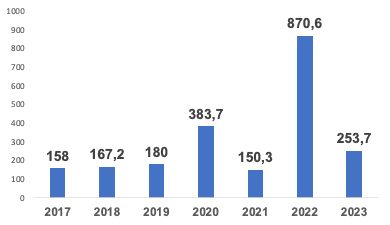
Thus, over the entire period of cooperation with IDB, Uzbekistan has been able to attract more than 3.7 billion USD from this organization for the implementation of various projects, including an unprecedented amount of 870.6 million USD in Y2022 (see Diag.1), attracted for the reconstruction and modernization of the “M-39 Tashkent-Termez road”, integrated development of rural areas, construction of a combined cycle gas turbine and other purposes. That makes Uzbekistan a leader among the CIS countries in terms of the amount of attracted funds from IDB (see Table 1). Given the country's share in the subscribed capital of the Bank in the amount of 14.9 million USD (0.03% of the total capital), the volume of funds raised looks impressive.
Undoubtedly, this indicator is a proof of the correctness of the ongoing socio-economic policy in the country, the successful implementation of the “Strategy of Action for the Five Priority Areas of Development of the Republic of Uzbekistan in 2017–2021”, expressed in the improvement of the system of state and social construction, the judicial and legal system, creation of favorable climate for business, large-scale reform in the field of monetary policy. It is worth noting that over the period 2017-2021, Uzbekistan’s total trade turnover with foreign countries increased 2-fold from 20.1 billion USD up to 41.1 billion USD (with Central Asian countries from 2.7 billion USD up to 6.3 billion USD), the personal income tax rate was reduced from 22.5% down to 12%, the VAT rate – from 20% down to 15%, the volume of gold and foreign exchange reserves increased from 26.4 billion USD up to 34.9 billion USD, the number of countries for a visa-free regime increased to 86 countries (only 18 countries in 2018), the number of higher educational institutions almost doubled from 77 to 141, etc. [30]
In continuation of the “Action Strategy” at the beginning of 2022 a “New Uzbekistan Development Strategy for 2022-2026” (hereinafter referred to as “Development Strategy”) was approved by Decree of the President of the Republic of Uzbekistan No. UP-60 dated 28.01.2022. The new “Development Strategy” is aimed at achieving exactly 100 goals within the framework of 7 priority areas for the development of Uzbekistan for the next 5 years and includes such measures as further liberalization, double increase of the volume of textile industry production, improvement of competition, attraction of more foreign investments to the economy, improvement of living standards of the population [32].
Current state of affairs of the textile industry in Uzbekistan.
Textile industry is considered as one of the strategically important sectors of the Uzbek economy. The presence of its own large raw material base and a relatively large market in neighboring countries make the development of textile and garment production in Uzbekistan one of the potential growth drivers.
A new stage of the development of the textile industry of Uzbekistan started in 2017. By the Presidential Decree dated December 21, 2016 "On the program of measures for the further development of the textile and garment-knitwear industry for 2017-2019", the enterprises, producing textile and garment-knitwear products were granted different kind tax and customs privileges (in the form of exemption from profit tax, property tax or release from customs payments for imported equipment, components, etc.). By the Decree of the President of the Republic of Uzbekistan dated December 14, 2017 № 5285 "On the advanced development of textile and garment-knitwear industry" there was developed a “roadmap” regarding improvement of the management system. personnel training, modernization of production, development of infrastructure, intensification of foreign economic activity, introduction of international standards in the textile industry [31].
The cluster system of textile production development was introduced in 2017, which allowed to improve the formation of unified production chains from raw materials to finished products, significantly reduce transaction costs for farmers of producers, thereby contributing to the price competitiveness of textile industry products.
As a result, the number of enterprises in the industry has increased by 2,4 times over the last six years from 7,700 to 18,400. The volume of investments increased from 518 mln. USD in 2017 to 1,6 bln. USD in 2022 [38]. In 2023, total volume of textile industry production amounted 8,2 bln. USD, employing more than 570 000 people by around 6 000 enterprises.
Due to the growth of processing of local raw materials within the regions in 2017 there were processed 40% of cotton fiber, in 2019 - 88%, in 2020 – 93% and in 2021 – 100%. Thus, there was ensured a cessation of export of raw materials (cotton fiber) and increase the share of semi-finished and finished industrial goods (yarn, fabric, clothing) in total export sales [23]. In the commodity structure of exports the share of textile yarn and fabric captures 13.5% and clothing – 4,0%.
The Decree of the President of the Republic of Uzbekistan NO. UP-5989 of May 5, 2020 “On urgent measures to support the textile and garment and knitwear industry” opened wide opportunities for textile export manufacturers. According to the Resolution, investment projects implemented in 2020 – 2025, as well as the provision of working capital to textile aria garment and knitwear enterprises, are financed from credit lines of the Fund for Reconstruction and Development of the Republic of Uzbekistan in the amount of $300 million, loans from commercial banks, borrowed funds from international financial institutions and lines of credit of foreign banks open to the textile and clothing and knitwear industries. There were organized export support headquarters, regional supportive representatives of the national association “Uzbektextilprom” in order to assist in the export of domestic textile products, study and solve existing problems [21].
The high growth dynamics of the textile industry and government support measures have increased the business activity and export potential of the industry. The volume of textile industry’s exports in 2023 totaled to 3,1 bln. USD and the geography of export sales increased up to 83 countries. Almost 80% of export fell on the markets of traditional partners of Uzbekistan – Russia, China and Turkey [39].
However, the share of products with high added value in the export of finished goods remains very low. This is largely explained by the lack of local companies, equipped under high-tech production sites to satisfy international certification rules of the developed countries. Most of enterprises in textile industry are formed as small and medium-sized enterprises (SME), which lack enough financial capacity to develop production facilities or to sell goods to foreign counteragents on credits terms, which is considered one of the competitive advantages of any supplier in the world market.
New prospects for further development of textile industry, using IsDB Group instruments.
In our opinion, further deepening of cooperation between Uzbekistan and the IsDB Group can play a significant role in the implementation of the “Development Strategy”, in particular, in reaching the following goals of the 3rd priority area (“Accelerated development of the national economy and ensuring high growth rates”):
- double increase of the volume of textile industry production (goal 22);
- expansion of financial resources in the country (goal 27);
- increasing the export potential of the country (goal 28);
- increasing the share of the private sector in GDP to 80%, in exports – to 60% (goal 29).
First of all, it should be noted that Uzbekistan compares favorably with other countries of the post-Soviet space by the large population in the country, predominantly Muslim. According to the Statistics Agency of Uzbekistan, in 2023 the country's population increased to 36.738 million, which is 45% of the total population of Central Asia. The large Muslim population creates an excellent platform for the introduction of Islamic principles of finance and risk management. The country has a large number of people, including entrepreneurs, who due to their religious beliefs do not take bank loans and do not use the services of insurance companies in terms of life and health insurance for family members and (or) company employees. At the same time, the lack of borrowed funds can limit the development of textile industry enterprises, especially SMEs, or the lack of insurance protection can put a family at risk in the event of the death of the breadwinner.
To date a number of Uzbek banks (Trustbank, Ipak-Yuli Bank, Uzpromstroybank and others) and insurance companies (APEX Insurance, TEMIRYO’L-SUG’URTA, GROSS) offer some Islamic financial products via so-called “Islamic window”. However, in our opinion, offering of such products by conventional banks or insurance companies will still contradict the religious feelings of conservative believers, who are convinced that the Islamic money fund should not be intermixed with the money fund of conventional financial structures and even managed within the “walls” of such organizations. The rationale behind this principle is taking all the necessary precautions to ensure that Islamic funds do not become mixed with other funds that may be involved with riba, gharar, maysir or haram activities [17]. This is, obviously, one of the reasons why a majority part of population of Uzbekistan, consisting mainly of Muslims, does not place its saving in Uzbek banks (only 3% of the population or 10% of private savings of the population). Although, the banking system of Uzbekistan showed significant improvements over the period 2017-2022, including, growth of ATMs from 445 to 11,000; increase in the number of debit cards from 19 million to 30 million; increase in the number of bank branches by 300; improved digitalization of banking services and as a consequence a 6-fold increase in users, etc.[35]
Moreover, consolidation of Islamic and conventional banking data might result in double-counting of the Islamic banking component and therefore an information on “Islamic windows” should be deconsolidated from the parent banks [25] or even better to be spun-off as separate legal entity. The principle of the “Islamic window” in conventional banks does not also meet all the requirements for the functioning of full-fledged Islamic banks in terms of approach to risk management, investment of funds, compliance of its internal organizational infrastructure with the achievement of the goals of effective management of the total portfolio of banking assets and even disclosure of information on aggregate indicators of banking activities. As an example, an Islamic bank prepares a separate “report on changes in restricted investments”, where the bank discloses how it has used depositors' funds, placed in restricted investment accounts, taking into account their wishes and restrictions.
Based on the above, it becomes highly important to form a full-fledged infrastructure for Islamic finance in the country, including the creation of independent Shariah-compliant banks and insurance companies, as well as a separate legislative framework, regulating the activities of Islamic financial organizations, a mechanism for guaranteeing deposits and Islamic securities for investing funds. In this respect, IDB can become the main partner of Uzbekistan in the implementation of this comprehensive work, taking into account also the fact that the development of the Islamic finance industry is one of the directions of the IDB’s activities according to its Charter. It’s worth to note that in 2018 a draft of Presidential Resolution on the creation of Islamic financial infrastructure and an Islamic bank in Uzbekistan was presented for public discussion. But the project did not receive further development. At the end of 2019, the Capital Market Development Agency of the Republic of Uzbekistan presented the “Capital Market Development Strategy for 2020-2025”, according to which it was planned to adopt a regulatory act on the introduction of Islamic sukuk bonds and begin issuing them from mid-2020. However, this legal act has not yet come into effect.
For Uzbekistan, including the relevant government departments, it would be a good solution to attract specialized specialists of IDB in the field of Islamic finance for direct participation in the development of individual laws on the organization and activities of Islamic financial institutions. Opening an IsDB representative office in Tashkent would make it possible to have specialized specialists on a permanent basis. It is believed that the entry into force of the necessary legislative acts will allow Uzbekistan to attract up to 10 billion USD of additional investment on an annual basis [29].
It is gratifying to note that IDB has been participating in the training of Uzbek specialists in the field of Islamic finance for many years. However, as noted above, there is a need for direct participation of IDB in the implementation of large-scale reforms in the financial sector, including its direct participation in the establishment of an Islamic bank(s) in Uzbekistan as one of the shareholders. In the world practice there are several examples of IDB’s participation in the ownership structure of Islamic banks (“Meezan bank” in Pakistan, “Bank of Khartoum” in Sudan, “Jaiz Bank” in Nigeria, “Albaraka Türk” in Turkey, etc. [33]), which had a beneficial effect on the development of the country's banking industry as a whole. Direct participation of IDB in the ownership structure of an Uzbek bank will have a positive impact not only on the activities of bank by attracting specialized specialists from other Muslim countries of the world, establishing cooperation with Islamic banks of IDB member countries, but can also contribute to increasing the diversification and resilience of the national financial system. This, in turn, can help in wide coverage of the population with financial services and expanding financial resources in the country.
One of the main barriers today to the development of SMEs in the world today is the inaccessibility of bank loans to a wide range of entrepreneurs. The World Bank's most recent estimates show that developing countries still have a financing gap for SMEs of around 19% of GDP or 5.7 trillion USD in total. Moreover, this indicator has not changed since 2015 [6].
According to the Agency of Statistics under the President of the Republic of Uzbekistan, as of 01.07.2023, the total number of operating SMEs in the country amounted to 411,1 thousand [37]. At the same time, only 13% of SMEs (about 53.4 thousand) has access to financing in conditions when this sector provides 74% of the country's workforce [36]. In Uzbekistan, this is also accompanied by a religious component of obtaining a loan from traditional sources. Our analysis of the corporate websites of the main commercial banks of Uzbekistan shows that the maximum loan volume allocated to SMEs is 5 billion soums at an annual rate of no less than 24%. This rate may be reduced by some b.p. if compensation is provided by the “State Fund for Support of Entrepreneurship”. But, this fund also has certain restrictions: no more than 30% of the loan rate is compensated; the loan term must be no more than 3 years; the amount of the guarantee cannot exceed 50% of the loan amount, the size of which should not exceed 2.5 billion soums [25].
The main difference between Islamic banking and the traditional model of bank lending is the refusal to use interest on loans (in Arabic “riba”). Since money is not a commodity under Sharia law, demanding payment for lending it is considered unfair exploitation and can negatively affect public welfare. Therefore, the Islamic banking system is not based on interest on loans, but on the principle of sharing profits from trade and investment between the lender and the borrower. It follows that the Islamic banking system is focused on the operations of the real sector and the prevention of excessive risk in financial activities. Incidentally, this showed its effectiveness during the global financial crisis of 2007-2008, when Islamic banks felt the consequences of the crisis much less than conventional banks [20]. It should also be noted that if for a conventional bank a client is a source of income, for an Islamic bank a client becomes an equal partner - an investor. As a result, Islamic banks do not allow or are not interested in the bankruptcy of its clients.
This financing model, which involves sharing risks between the lender and the borrower, is preferable for Uzbek SMEs. Especially at the initial stage of the formation of SMEs, when they do not have their own supply of financial cushion or collateral (guarantee) to obtain loans from commercial banks. The presence of Islamic banks in the country, including with the participation of IDB as a partner or shareholder, can fill the existing gap in the availability of loans for SMEs on preferential terms (no interest payments, no collateral, risk sharing with the creditor bank, support for SMEs throughout its entire business life cycle). In fact, the Islamic banking model was initially based on and solves the problem of overcoming a number of social problems of society, including through stimulating the development of SMEs. Widespread advertising and promotion of the principles of Islamic finance through mass media and social networks will cover a large part of the population and SMEs, and the introduction of subjects on Islamic finance in universities with the involvement of IDB specialists as lecturers and the publication of research materials on Islamic finance will help to train the country’s own staff and improve the financial literacy of the population.
It can also stimulate the development of crowdfunding in the country according to Islamic principles, when investors - individuals professing the religion of Islam, can invest their funds in textile projects aimed at solving socially important problems, such as creating new jobs in the regions, especially for women, to stimulate the use of environmentally friendly materials and new technologies to minimize waste, etc. An example of a successful project in the textile industry realized through crowdfunding is the project of eco-clothing “Osoka” on a large Russian crowdfunding platform “Boomstarter” [15].
One of the important structural divisions of the IDB Group is ICIEC, designed to support trade and investment between member countries of the IDB Group through Shariah-compliant risk insurance. By the nature of its activities, ICIEC is similar to the Export Credit Agency (ECA) of various countries of the world, which first started working in Great Britain after the First World War in order to restore the international trading system and link the colonies to trade with the mother country [22]. Today practically all countries of the world have their own ECA as part of the system of state stimulation of foreign economic activity, engaged in export-import insurance, issuing guarantees to commercial banks for issued financing to the exporter and a number of other services, including the issuance of sureties (bonds), export factoring insurance, information and consulting services, etc. ICIEC provides almost all of the above services only in accordance with Shariah norms and mainly for member countries of the IDB Group. Today, 49 states are members of ICIEC. Among the CIS member countries, Kazakhstan was the first to join this organization in 2003 and since joining it has received financial support from ICIEC in the amount of more than 7 billion USD [34]. Uzbekistan joined ICIEC second after Kazakhstan among the CIS countries, but only in June 2019. In a short period, ICIEC has supported with its insurance coverage trade operations and investment projects in Uzbekistan worth of 758 million USD. In 2020, ICIEC signed a “Memorandum of Understanding” with the leading insurance company of Uzbekistan – JSC EIIC “Uzbekinvest”.
In a context where ECA does not yet exist in Uzbekistan, deepening a cooperation with ICIEC could help to increase the competitiveness of textile producers in international markets through the provision of comprehensive export insurance support services. ICIEC’s cooperation with Uzbekistan could be built on the basis of the organization’s interaction with local insurance companies (first and foremost with Uzbekinvest) through reinsurance or co-insurance of risks, primarily for SMEs in textile industry, to strengthen their export potential. As it is known, one of the main ways to gain a competitive advantage for Uzbek SMEs when entering foreign markets is the possibility of providing a foreign partner (counterparty) with an export credit in the form of a deferred payment for goods supplied. At the same time, this method of trading is associated with the risk of non-payment due to the insolvency of the counterparty (commercial risks) or the inability to transfer money due to the presence of restrictive factors beyond its control, such as a ban on transferring currency outside the country, deprivation property rights (confiscation, nationalization, expropriation), the introduction of an embargo, the start of hostilities in the country, etc. (political risks). Non-payment of money for delivered products from several foreign contractors can often have a catastrophic impact on the activities of SMEs.
In this regard, it becomes necessary for a producer in textile industry to obtain additional reliable insurance guarantees that ensure its interests outside its country. ICIEC, together with Uzbek insurance companies, can provide such insurance coverage to local textile industry producers. This coverage can be organized via insuring commercial and political risks of national producers as part of supporting exports in new and risky foreign markets, providing information and consulting services (such as providing information on the profile and financial position of a foreign counterparty, legal requirements of various sectors of foreign economies, consultations on customs administration, on issues of currency control, etc.), issuing an insurance guarantee to commercial banks to provide financial loans needed for textile industry producers for the purposes of production and subsequent export, etc.
As noted above, Islamic financial institutions consider clients as partners and do not allow them to go bankrupt. From this point of view, the participation of ICIEC in insuring (or reinsuring) the export operations of Uzbek producers of textile could enable the parties of foreign trade contract to always try to find a compromise solution in the event of insured events (non-payment for delivered goods) instead of starting legal proceedings, which is the most common, yet the most time-consuming method of debt collection. That compromise solution means making continued shipments under Insurer’s coverage in proportion to payments received from debtor, agreeing on schemes for restructuring the debt, debt cession, buyback of goods, etc. That would allow the exporter not to deteriorate the relationship with foreign counterparty and not to lose a potential foreign market, keep the level of overdue accounts receivable under control and improve the exporter’s credit profile.
Moreover, insurance coverage of business supplies always helps to protect the balance sheet of SME and the interests of shareholders, and also serves as a good tool for attracting bank financing. Accordingly, the presence of support from ICIEC will automatically provide an opportunity to receive financing from IDB for the purpose of expanding business and export destinations of textile producers under preferential conditions. Because, availability of insurance coverage from ICIEC will guarantee IDB or any other Uzbek commercial bank, being local partner of IDB and financing export sales of SME in textile industry, a return of funds in case of credit default. This scheme will also allow an increase in the volume of lending by the banks themselves due to the release of credit limits (reserves) on insured transactions, reduction of the credit rate, increase in the competitiveness of the credit product with the insurance support of local insurer and ICIEC (acting as the reinsurer). It is noteworthy that the Islamic financial system contains the concept of “gharar” (elimination of uncertainty), which is always taken into account in the conclusion of any transaction, approval of any project. On this basis, it follows that the parties will always try to eliminate any unjustified risk or asymmetry of information when concluding a transaction, which disciplines the parties and allows financial institutions to avoid unjustified losses.
Analysis of Uzbekistan’s export sales demonstrate that the top 10 countries account for 65% of total exports of the country, among which 7 countries are IDB member countries (see Table 2). The Middle East region, which is considered as of the biggest markets for the world textile producers, accounts for approximately 9-12% of Uzbekistan's exports (around 1,25 billion – 2,3 billion USD) for the period 2018-2023. In a context where IDB attaches paramount importance to the intensification of the development of mutual trade between all member countries of the organization, the Middle East region may become one of the important business development areas for Uzbek SMEs in textile industry.
Besides, an insurance support for SMEs from ICIEC together with Uzbek insurance companies will provide additional benefits to SMEs themselves. Firstly, the presence of an insurance policy and constant interaction with insurance institutions will allow local SMEs to establish and constantly improve the level of risk management of the enterprise. Secondly, in case of default from foreign partner and occurrence of an insured event, SME will be able to take advantage of information and consulting support from ICIEC or IDB in those countries where they have their representative offices or local partners. Thirdly, providing deferred payment to foreign partners on terms below market conditions, given the financial support of IDB and ICIEC, will enable Uzbek SMEs in textile industry to strengthen partnerships with foreign buyers by providing flexible payment terms and gradually conquer foreign markets.
Conclusions
We can note that the cooperation between Uzbekistan and the IsDB has enormous, not yet fully explored, potential. This is, first of all, the direct involvement of the IsDB in the implementation of large-scale reforms in Uzbekistan in the field of Islamic finance. The formation of a strong legislative framework regulating the activities of Islamic financial institutions and instruments is aimed at solving an important long-term task – modernizing the country's financial market and attracting direct investment from the Muslim world to the country.
The establishment of Islamic financial institutions in the country will make it possible to reach that part of the population that is strongly committed to religion and does not trust traditional financial institutions. If SMEs are supported on the terms offered by the Islamic financing model, Uzbekistan can expand trade relations with the outside world, improve its export potential, and create new jobs. The latter is especially important in regions and rural areas where employment level remains low.
As part of the country's “Development Strategy”, Uzbekistan aims to increase the country's export potential, which can allow it to resolve the issue of trade deficit and strengthen its international position on a regional and global scale. Deeping a cooperation with ICIEC with a focus on insuring export operations of local business entities in textile industry would let them securely open new foreign markets, expand local industrial production and strengthen the real sector of the economy as a whole. SMEs, which play an important role in the economy of Uzbekistan, can become key drivers of growth and stabilization of the foreign trade balance, value-added formation and, as a result, strengthening the contribution of the total volume of foreign trade to the country’s GDP growth.
References:
- Abdullaev, R.V. (2019) Basic principles of Islamic banking and trends in the development of cooperation between Uzbekistan and the Islamic Development Bank / R. V. Abdullaev // Paradigmata Poznani. - 2019. - № 1. - p. 35-41.
- Abdullaev R.V. (2023) Comparative analysis of social protection systems in Islamic traditional economies. / R. V. Abdullaev // O’zbekiston Milliy axborot agentligi O’zA Ilm-fan bo’limit. Elektron jurnal. - 2023. - № 10 (48). - p. 10-15.
- Abdullaev R.V. (2023) Uzbekistan – Islamic Development Bank: development cooperation. URL: https://uza.uz/uz/posts/ozbekiston-islom-taraqqiyot-banki-taraqqiyot-yolidagi-hamkorlik_474298
- Andrianov V.D. (2019) The main directions of the Islamic development bank and financial instruments with Islamic specificity / V. D. Andrianov // Belarusian Economic Journal. - 2019. - № 4(89). - p. 27-43.
- Bekkin R.I. (2010) Islamic economic model and modern world. M. Mardjani, 2010.
- Carvajal A.F., Didier T. Boosting SME finance for growth. The case for more effective support policies. International Bank for Reconstruction and Development. The World Bank. September 2024. 75 pages. URL:
- Chapra M. Umer. (1992) Islam and economic challenge. Leicester, 1992.
- Geoffrey F. Gresh. (2007) The rise of Islamic banking and finance in Central Asia. The Fletcher school online journal for issues related to Southwest Asia and Islamic Civilization. Fall 2007. – p.1-10.
- Hadiullina G.N. (2018) Features of Islamic insurance and the possibility of implementing its provisions in the modern Russian economy / G. N. Khadiullina // Horizons of Economics. - 2018. - № 1(41). - p. 73-78.
- Hassan, M. Kabir. (1999) Islamic Banking in Theory and Practice: The Experience of Bangladesh. Managerial Finance. 25:5:1999:60113.
- Imamkulieva E. E. Approaches to the development of corporate Islamic banking in the post-Soviet space and the Middle East (by the example of Kazakhstan and the UAE) / E. E. Imamkulieva, D. R. Sabitova // Middle East Economy. - 2024. - Т. 1, № 1. - p. 48-53.
- Imamnazarov J. (2020). Analyzing the landscape of Islamic financial instruments in Uzbekistan
- Isaeva E. A. Islamic banking: basic rules and principles, prospects of development in modern conditions / E. A. Isaeva // Financial markets and banks. - 2023. - № 6. - p. 140-146.
- Kenzhaliev N. U. Legal regulation of the Islamic finances: comparative analysis of the legal framework of the Republic of Kazakhstan, "Astana" International financial centre and United Kingdom / N. U. Kenzhaliev // Bulletin of Institute of Legislation and Legal Information of the Republic of Kazakhstan. – 2023. – No. 4(75). – P. 241-249.
- Kharisova F.I., Derzaeva G.G., Dashin A.K., Umarov H.S. Crowdfunding management on Islamic principles / Izvestiya vysokikh uchebnykh obrazovaniya. Technology of textile industry. - 2023. - № 6(408). – p. 279-289.
- Kyrlan M. G. Legal regulation of investments in Islamic banking: the experience of the Russian Federation and the Republic of Azerbaijan / M. G. Kyrlan // Eurasian Bar. - 2024. - № 4(69). - p. 164-167.
- Juan Solé (2007) Introducing Islamic Banks into Conventional Banking Systems. IMF Working Paper. July 2007. p. 28.
- Juravlev A.Yu. (2004) Functioning principles of Islamic banks // Islamic finance in the modern world: economic and legal aspects // edited by Bekkin R.I. – M., 2004.
- Khan, M. S. and Mirakhor A. (1985) The Financial Systems and Monetary Policy in an Islamic Economy. Research Paper, International Monetary Fund, Washington, USA
- M. Hasan, J. Dridi. (2010) The effects of the global crisis on Islamic and Conventional Banks: a comparative study. IMF Working Paper. WP/10/201. 2010, p. 33.
- Olimov A.A., Xasanboev A. F. Textile industry of Uzbekistan: achievements and problems. Texas Journal of Engineering and Technology. ISSN NO: 2770-4491. Date of publication: 22-12-2022. p. 220-226.
- Umarov Kh. S. (2020) On the history of creation and modern role of export credit agencies / Kh. S. Umarov // Insurance business. - 2020. - № 1(322). - p. 22-27.
- Yakubova, E. T. Textile industry: the aspiration of regions to new horizons / E. T. Yakubova // Economics and Finance (Uzbekistan). - 2022. - № 10. - p. 19-23.
- Core Principle for Islamic Finance Regulation (Banking Segment) (CPIFR) of Islamic Financial Services Board (IFSB). April 2015. p. 82.
- Core Principle for Islamic Finance Regulation (Banking Segment) (CPIFR) of Islamic Financial Services Board (IFSB). April 2015. p. 82.
- Decree of the President of the Republic of Uzbekistan №P-150 from 09.06.2022. URL: https://static.norma.uz/doc/doc_5/150%20(1).pdf
- Annual Report of IsDB for 2003-2004, p. 27.
- Annual Report of IsDB for 2016, p. 112.
- (2018) Islamic bank development to provide $1,3 billion to Uzbekistan. September 20, 2018. URL: https://www.rbasia.uz/post/2018/09/20/islamic-development-bank-to-provide-13-billion-to-uzbekistan
- (2019) The IDB explained why it is beneficial for Uzbekistan to develop Islamic banking. April 16, 2019. URL: https://uz.sputniknews.ru/20190416/V-IBR-obsnili-pochemu-Uzbekistanu-nuzhno-razvivat-islamskiy-banking-11251847.html
- (2021) Results of implementation of the "Strategy of actions on five priority directions of development of Uzbekistan in 2017-2021. September 07, 2021. URL: https://novayaepoxa.com/itogi-realizacii-strategii-deystviy/386203/
- (2021) Textile industry: main results of the implementation of the Development Strategy of Uzbekistan in the period 2017-2020. URL: https://imrs.uz/publications/articles-and-abstracts/textile
- (2022) A meaningful priority in Uzbekistan's Development Strategy for 2022-2026. February 17, 2022. URL: https://adolat.uz/ru/uzbekiston/znachimyj-prioritet-v-strategii-razvitiya-uzbekistana-na-2022-2026-gody
- (2022) IsDB’s activites for Islamic finance sector development. 10 February 2022. URL: https://tossd.org/docs/Seminar%201%20-%20IsDB%E2%80%99s%20Activities%20for%20Islamic%20Finance%20Sector%20Development.pdf
- (2022) ICIEC Town Hall – Central Asia in Transition. URL: https://iciec.isdb.org/insights/iciec-town-hall-central-asia-in-transition/
- (2023) From Livestock to Lifetime Savings: Improving Financial Inclusion in Uzbekistan. January 25, 2023 URL: https://blogs.worldbank.org/psd/livestock-lifelong-savings-improving-financial-inclusion-uzbekistan
- (2023) ADB and SQB sign a $50 million loan to support privatization and expand lending to MSMEs in Uzbekistan. November 10, 2023. URL: https://www.adb.org/ru/news/adb-sqb-sign-50-million-loan-support-privatization-and-expand-lending-msmes-uzbekistan
- (2023) Small enterprises and microfirms in operation. September 29, 2023 URL: https://stat.uz/ru/press-tsentr/novosti-goskomstata/44931-faoliyat-yuritayotgan-kichik-korxona-va-mikrofirmalar.
- (2023) Development of Uzbekistan's textile and garment and knitwear industry in 2017-2022: infographics. URL: https://yuz.uz/ru/news/razvitie-tekstilnoy-i-shveyno-trikotajnoy-promshlennosti-uzbekistana-v-2017-2022-godax-infografika
- (2024) “Our only sure way forward in the textile sector is complete recycling of raw materials” – President. URL: https://www.gazeta.uz/ru/2024/04/17/textile/
- (2024) Islamic Development Bank to support Uzbekistan in transition to green economy. November 07, 2024. URL: https://yuz.uz/ru/news/islamskiy-bank-razvitiya-podderjit-uzbekistan-v-perexode-k-zelenoy-ekonomike
Diag. 1. The amount of allocated funding to Uzbekistan for the period 2018-2023, in million USD.
Source: compiled by the author based on data from the Annual Reports of IDB for the period 2018-2023.
Tab. 1. The total amount of approved funds to some CIS countries by IDB for the period of 1991-2023 (millions of USD)
Source: Annual report of IDB for 2023.
Azerbaijan | Kazakhstan | Kyrgyzstan | Tajikistan | Turkmenistan | Uzbekistan | |
|---|---|---|---|---|---|---|
General volume approved funds | 1204.4 | 2973.7 | 525.8 | 753.4 | 1236.2 | 3740.5 |
Grand total projects (in numbers) | 79 | 71 | 78 | 101 | 30 | 156 |
Share in signed capital | 56.49 | 59.91 | 28.67 | 20.15 | 5.5 | 14.91 |
Approved Funds/Subscribed Capital Ratio | 2132% | 4964% | 1834% | 3739% | 22476% | 25087% |
Tab. 2. Main export partner countries of Uzbekistan for the period 2018-2023. ( millions of USD)
Source: developed by the author based on data from the Statistics Agency under the President of the Republic of Uzbekistan.
Country | 2018 | 2019 | 2020 | 2021 | 2022 | 2023 | |
|---|---|---|---|---|---|---|---|
1 | Russia | 2117 | 2 532 | 1,486 | 2,088 | 3,099 | 3,496 |
2 | China | 2 875 | 2,529 | 1,937 | 2,529 | 2 511 | 2,487 |
3 | Turkey | 945 | 1 218 | 1,019 | 1 692 | 1,512 | 1,263 |
4 | Kazakhstan | 1 352 | 1 393 | 98 | 1 178 | 1 393 | 1,417 |
5 | Kyrgyzstan | 270 | 670 | 760 | 792 | 978 | 634 |
6 | Afghanistan | 603 | 617 | 777 | 667 | 751 | 857 |
7 | Tajikistan | 237 | 328 | 405 | 502 | 521 | 608 |
8 | Canada | 5 | 6 | 142 | 200 | 227 | 41 |
9 | Turkmenistan | 60 | 144 | 126 | 192 | 195 | 172 |
10 | Iran | 173 | 220 | 142 | 177 | 140 | 181 |
Total export | 13,991 | 17,459 | 15 102 | 16 663 | 19,294 | 24,869 | |
Total export to TOP-10 | 8 637 | 9,656 | 7 703 | 10,018 | 11 327 | 11,156 | |
Export to IsDB member-countries among TOP-10 | 3,639 | 4,589 | 4 138 | 5 201 | 5 490 | 5 132 | |
Share of TOP-10 in total export | 62% | 55% | 51% | 60% | 59% | 45% | |
Share of IsDB member-countries among TOP-10 | 26% | 26% | 27% | 31% | 28% | 21% | |
Share of SMEs in export | 27% | 27% | 21% | 20% | 30% | 30% |
Keywords: IsDB, Islamic finance, Uzbek textile industry, SME, ICIEC, insurance support.
Хасан Умаров